BS EN 1177: how playground surfacing is tested.
BS EN 1177 is the European standard titled Impact attenuating playground surfacing — Methods of test for determination of impact attenuation. It sets out how to measure a surface's ability to absorb the energy of a fall, and how to express that as a critical fall height. The current edition is BS EN 1177:2018, incorporating amendment A1:2023 and subsequent corrigenda.
How it fits with EN 1176
EN 1177 works alongside EN 1176, the standard for the play equipment itself. EN 1176-1 requires impact-attenuating surfacing under any equipment with a free height of fall greater than 600 mm, and caps the maximum free height of fall at 3 m. EN 1177 is the test that confirms a given surface meets the protection needed for that height.
What the 2018 edition changed
The 2018 revision introduced a second pass/fail measure. Surfaces must now satisfy both a Head Injury Criterion limit and a peak-deceleration limit, and a second on-site method was added for confirming impact attenuation after installation.
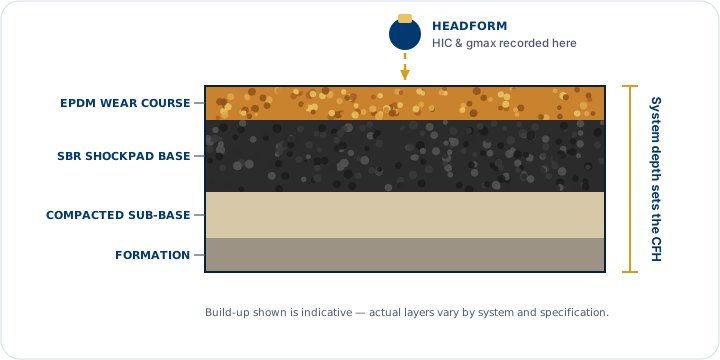
| Element | Requirement under BS EN 1177:2018+A1:2023 |
|---|---|
| Head Injury Criterion (HIC) | Must not exceed 1000 at the rated fall height. |
| Peak deceleration (gmax) | Must not exceed 200 g. |
| Method 1 | Determination of critical fall height — laboratory or on site. |
| Method 2 | On-site measurement of impact attenuation after installation / periodically. |
| Result reported as | Critical fall height in metres to two decimal places, with measurement uncertainty. |
| Laboratory conditions | Tests conducted at 23 °C ± 5 °C. |
| Also applies to | Impact areas for outdoor fitness and parkour equipment. |